Quick answer
To calculate mean median mode, first classify the problem, preserve the meaning of every transformation, and verify the final result in the original statement. For the worked example mean = sum(xi)/n, the result is mean=5, median=4.5, mode=4. The method below shows why that result follows rather than presenting it as an unexplained calculator output.
Identify the problem before calculating
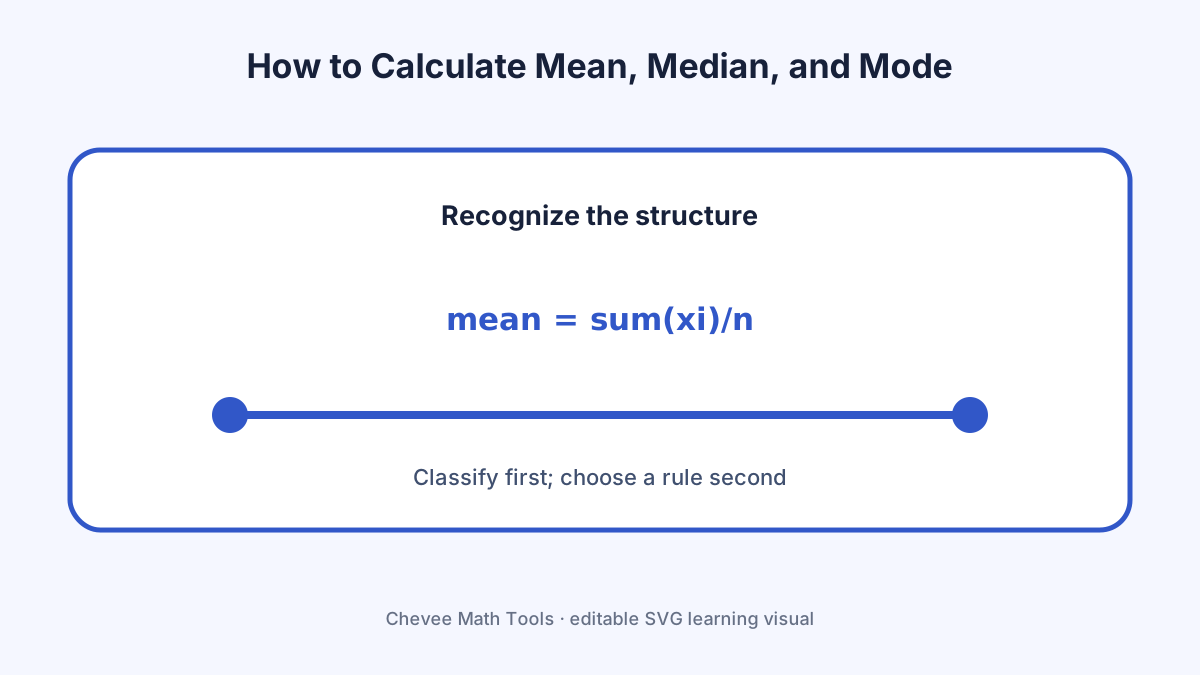
Mean uses every value, median is the middle ordered value, and mode is the most frequent value. A data set may have no mode or more than one mode. This classification step matters because a familiar-looking expression can require a different rule when its structure changes. Write down any domain restriction, unit, dimension, or reference value before manipulating the symbols.
State whether the data are a population or sample and preserve enough precision through intermediate calculations. The reported number should be interpreted with the distribution, not in isolation.
Step-by-step method
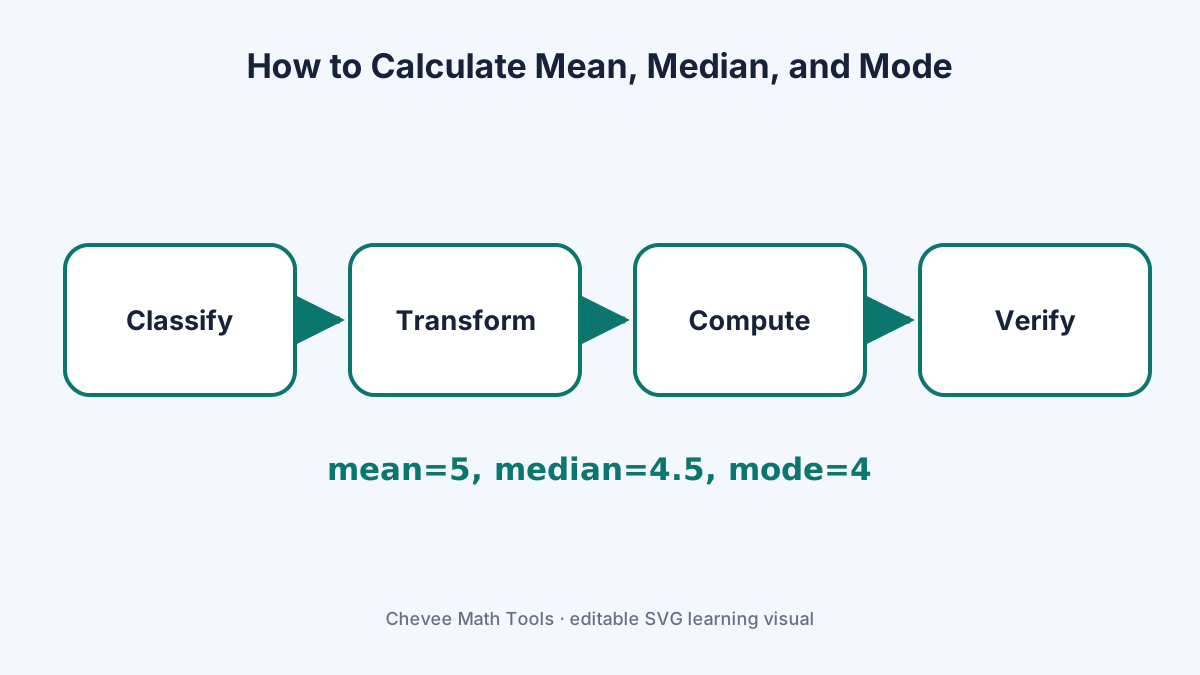
- List the observations and sort them for median and mode.
- Add all values and divide by the count for the mean.
- Select the middle value, or average the two middle values, for the median.
- Count frequencies to identify the mode.
- Compare the measures and note outliers or skew.
Each line should answer two questions: what operation was performed, and why that operation preserves or correctly changes the mathematical object. When a calculator or browser tool is used, keep the original input visible so the output can be compared with the source problem.
Worked example
- For 2,4,4,4,5,5,7,9, the sum is 40 and n=8, so mean=5.
- The middle values are 4 and 5, so median=4.5.
- The most frequent value is 4, so mode=4.
- The three measures describe different aspects of the same distribution.
The result mean=5, median=4.5, mode=4 is not accepted solely because it looks plausible. The example retains the intermediate quantities that make a sign, denominator, exponent, dimension, or rounding mistake visible.
Read the visual explanation
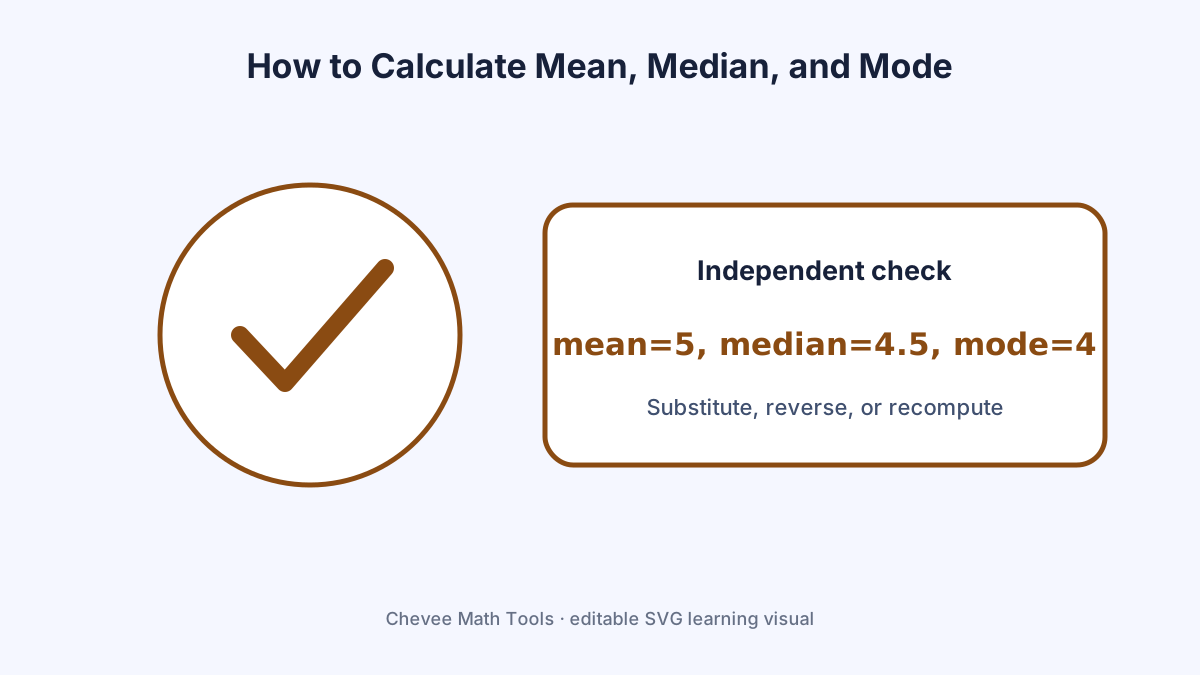
The three diagrams on this page separate the concept, the execution sequence, and the final check. Use the concept diagram to recognize the structure, the workflow diagram while solving, and the verification diagram after obtaining a candidate result. The diagrams are SVG files, so text remains selectable and the graphics stay sharp on mobile screens and when printed.
Common mistakes
- Finding a median before sorting.
- Dividing the sum by the wrong count.
- Claiming a mode when every value occurs once.
A reliable correction strategy is to return to the earliest line where the mathematical object changed. Repeating only the final arithmetic often reproduces the same hidden setup error.
Verify the result
Check the sum and count again; inspect the ordered list to confirm the middle positions and frequencies. Also inspect whether the answer has the correct sign, scale, units, dimension, and domain. For an equation, substitution is decisive. For an inverse pair such as differentiation and integration, apply the inverse operation. For a statistical or financial result, recompute one intermediate quantity and compare it with an independent method.
Use the tool without losing the reasoning
Open the matching browser tool with the worked input when available. The tool is useful for recomputation and output formatting, but the page's decision rule remains necessary: unsupported expressions, ambiguous units, and incorrect assumptions can produce a neat result that answers a different question.
Keep a compact record containing the original problem, the selected method, intermediate values, the final result, and the verification. That record is more useful for study, teaching, and debugging than an isolated answer.
Visual explanation
How this guide was checked
Review method: Problem classification review, independent recomputation, reverse-operation or substitution check, source comparison, and visual accessibility review
Verified against: OpenStax instructional references and the page-specific mathematical sources listed below
What changed: Removed repeated sitewide boilerplate and added content-type-specific decision, verification, and applicability guidance for this exact task.
Page purpose: how to calculate mean median mode — Learn a reliable method, follow a worked example, and verify the result
Automated quality check: Passed critical indexing checks.
Verification references
These primary standards and official documentation pages were used to check character identity, syntax, or platform behavior described above.
- Introductory Statistics 2eOpenStax, Rice University — Reviewed probability and statistics definitions, notation, and formulas.
- Digital Library of Mathematical FunctionsNational Institute of Standards and Technology — Definitions, notation, identities, and reference material for mathematical functions.