Quick answer
To integrate basic functions, first classify the problem, preserve the meaning of every transformation, and verify the final result in the original statement. For the worked example ∫ x^n dx = x^(n+1)/(n+1) + C, the result is x^4/4 + 2x^2 + C. The method below shows why that result follows rather than presenting it as an unexplained calculator output.
Identify the problem before calculating
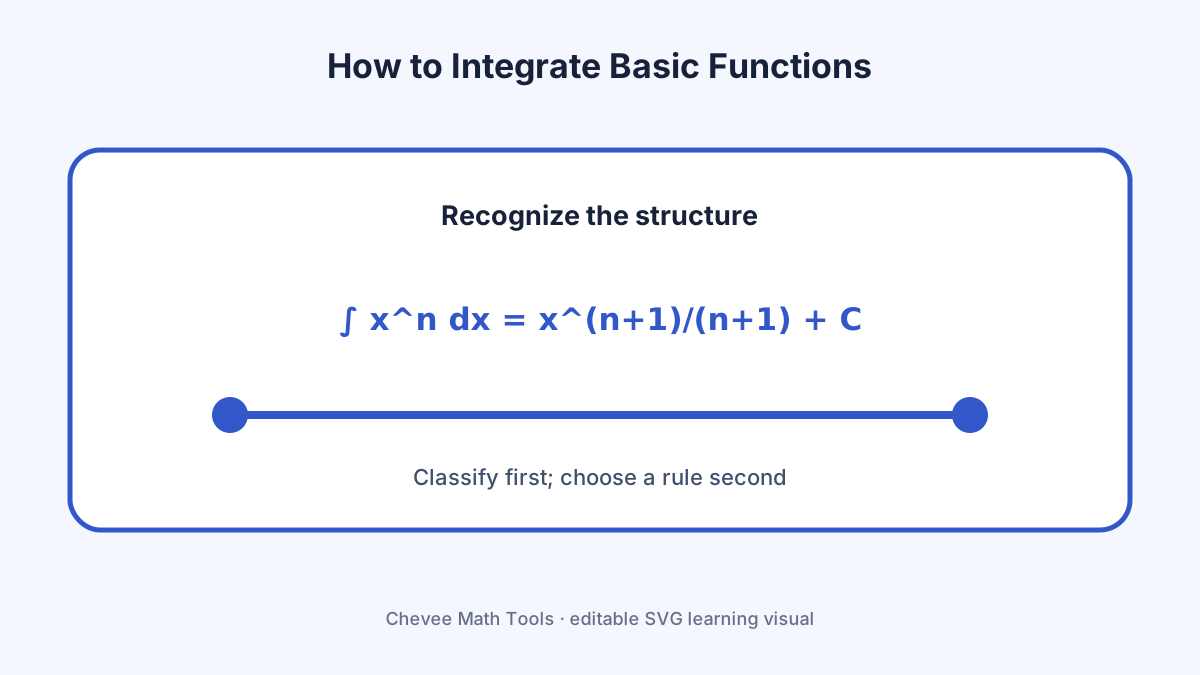
An indefinite integral asks for a family of antiderivatives. The basic power rule excludes n = -1, which instead gives a logarithm. This classification step matters because a familiar-looking expression can require a different rule when its structure changes. Write down any domain restriction, unit, dimension, or reference value before manipulating the symbols.
Differentation and integration rules have domains and structural triggers. Identify the outer operation before applying a memorized rule, and verify with the inverse operation whenever possible.
Step-by-step method
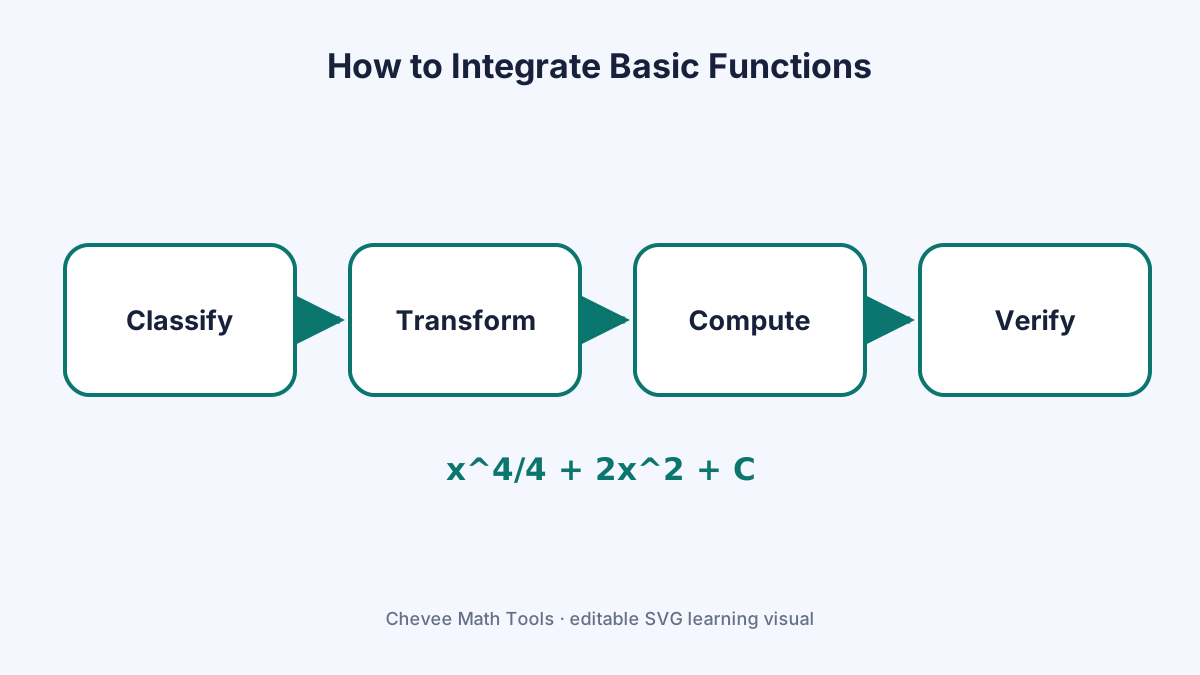
- Simplify the integrand and split sums into separate terms.
- Increase a power by one.
- Divide by the new exponent.
- Use special forms for x^-1, exponentials, and trigonometric functions.
- Add a single constant C and differentiate to verify.
Each line should answer two questions: what operation was performed, and why that operation preserves or correctly changes the mathematical object. When a calculator or browser tool is used, keep the original input visible so the output can be compared with the source problem.
Worked example
- Integrate x^3 + 4x.
- The antiderivative of x^3 is x^4/4.
- The antiderivative of 4x is 2x^2.
- Thus the result is x^4/4 + 2x^2 + C.
The result x^4/4 + 2x^2 + C is not accepted solely because it looks plausible. The example retains the intermediate quantities that make a sign, denominator, exponent, dimension, or rounding mistake visible.
Read the visual explanation
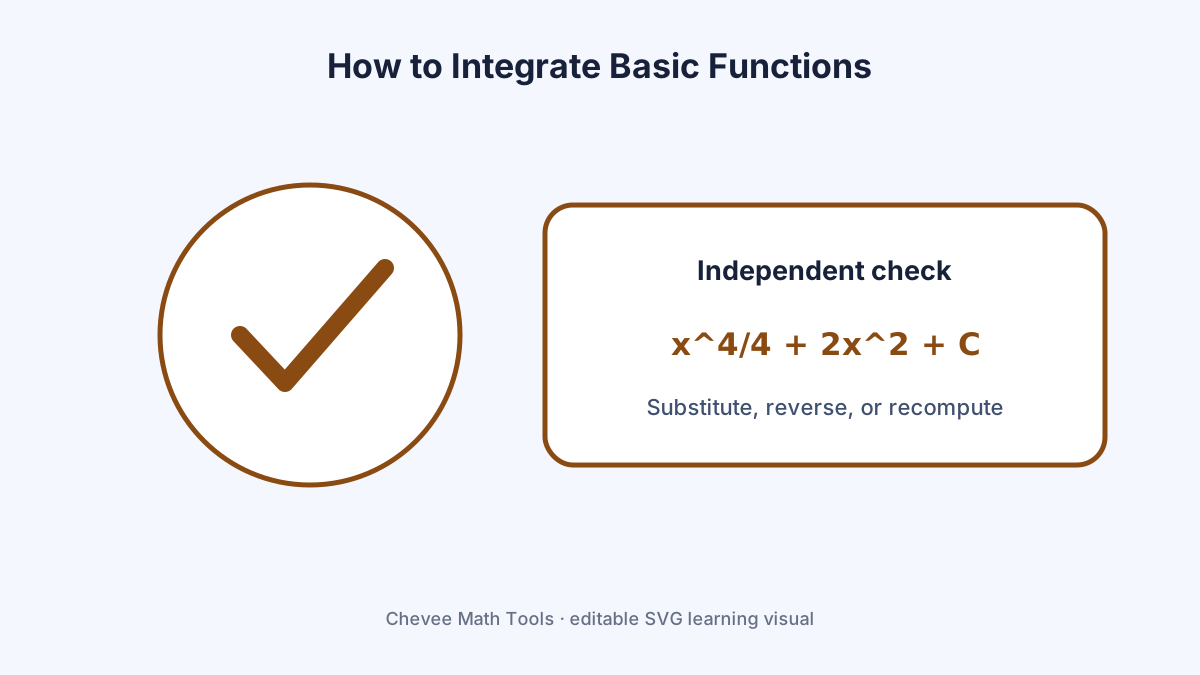
The three diagrams on this page separate the concept, the execution sequence, and the final check. Use the concept diagram to recognize the structure, the workflow diagram while solving, and the verification diagram after obtaining a candidate result. The diagrams are SVG files, so text remains selectable and the graphics stay sharp on mobile screens and when printed.
Common mistakes
- Using the power formula when n = -1.
- Omitting the constant of integration.
- Changing coefficients inconsistently during division.
A reliable correction strategy is to return to the earliest line where the mathematical object changed. Repeating only the final arithmetic often reproduces the same hidden setup error.
Verify the result
Differentiate x^4/4 + 2x^2 + C; the result is x^3 + 4x. Also inspect whether the answer has the correct sign, scale, units, dimension, and domain. For an equation, substitution is decisive. For an inverse pair such as differentiation and integration, apply the inverse operation. For a statistical or financial result, recompute one intermediate quantity and compare it with an independent method.
Use the tool without losing the reasoning
Open the related reviewed reference with the worked input when available. The linked reference is useful for checking notation and assumptions, but the page's decision rule remains necessary: unsupported expressions, ambiguous units, and incorrect assumptions can produce a neat result that answers a different question.
Keep a compact record containing the original problem, the selected method, intermediate values, the final result, and the verification. That record is more useful for study, teaching, and debugging than an isolated answer.
Visual explanation
How this guide was checked
Review method: Problem classification review, independent recomputation, reverse-operation or substitution check, source comparison, and visual accessibility review
Verified against: OpenStax instructional references and the page-specific mathematical sources listed below
What changed: Removed repeated sitewide boilerplate and added content-type-specific decision, verification, and applicability guidance for this exact task.
Page purpose: how to integrate basic functions — Learn a reliable method, follow a worked example, and verify the result
Automated quality check: Passed critical indexing checks.
Verification references
These primary standards and official documentation pages were used to check character identity, syntax, or platform behavior described above.
- Calculus Volume 1OpenStax, Rice University — Reviewed limits, derivatives, integrals, and foundational calculus formulas.
- Digital Library of Mathematical FunctionsNational Institute of Standards and Technology — Definitions, notation, identities, and reference material for mathematical functions.